Neighborhood Scorecard
Source: · HUD FMR FY2024 · FBI UCR (latest county year) · DOL NDCP
60649 – Chicago, IL
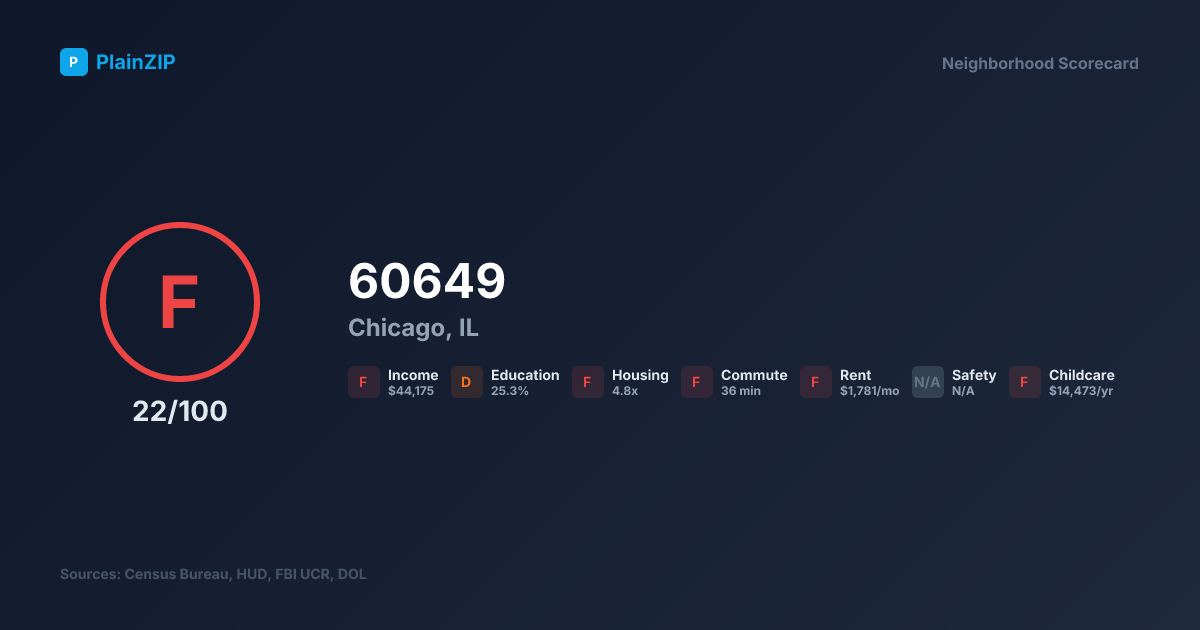
The neighborhood scorecard for ZIP 60649 in Chicago, IL blends seven federal datasets into a single letter grade of F (22/100). The underlying inputs pulled for this ZIP include a median household income of $44,175, a median home value of $213,200, 25.3% of adults with a bachelor's degree or higher, and an average commute of 36 minutes. Every value comes directly from Census ACS 5-Year Estimates tied to ZIP 60649, not a national average mapped onto the ZIP.
Cross-agency inputs extend the score beyond Census demographics. Department of Labor county childcare data lists infant center-based care at $14,473 per year, which the scorecard weighs against local median income to form the childcare grade. If any of these feeds is missing for 60649, the scorecard transparently drops that dimension rather than inventing a score.
Reading the grade means reading the dimensions together. The overall F score for 60649 reflects a weighted blend, Income (20%), Safety (20%), Housing (15%), Rent (15%), Education (10%), Commute (10%), and Childcare (10%) - and each dimension is benchmarked against national percentiles rather than in-state-only comparisons. Areas pulling the overall grade down are income, education, housing, commute, rent, childcare. The 6 nearby ZIP codes listed below provide immediate geographic context, two adjacent ZIPs can land several grade letters apart due to school-district boundaries, zoning, and commute arteries.
Transparent derived index from federal sources, not an official government rating. Based on income, housing cost, safety, education, commute, and childcare-cost data from federal sources, not school test scores, walkability, weather, culture, or day-to-day livability. See the exact dimensions, weights, and formula.
Score Breakdown
Income
FMedian household income
Education
DBachelor's degree or higher
Housing
FHome value $213,200 vs income
Commute
FAverage commute time
Rent
F2BR fair market rent (county; 48% of income)
Safety
N/AViolent crime rate (county)
Childcare
FCenter-based infant care (county; 33% of income)
Share Your Neighborhood Score
Download or share this scorecard with friends, family, or on social media.
What This Means
Chicago, IL (60649) receives an overall grade of F based on publicly available data from the Census Bureau, HUD, FBI, and Department of Labor. Challenges include income and housing and commute and rent and childcare. Data was unavailable for safety – these dimensions were excluded from the overall score.
Nearby ZIP Scorecards
Side-by-side: Compare 60649 vs 60637 →
Frequently Asked Questions
What is the overall score for ZIP 60649?▼
Is 60649 a good place to live?▼
How is the neighborhood scorecard calculated?▼
Official Data Resources
Vintages stay separate: ACS demographics/housing 2019–2023; HUD FMR FY2024; FBI UCR and DOL NDCP use each feed's latest county year. Rent and childcare grades are exploratory joins of those feeds against ACS median income, not a claim that every agency shares one fiscal year. Source: U.S. Census Bureau ACS 5-Year Estimates. Source: HUD Fair Market Rents. Source: FBI Uniform Crime Report. Source: DOL NDCP childcare prices. Verify with HUD →
Read our methodology to see how this data is sourced, computed, and verified.